Devils swop the classroom for the court room
10 Dec
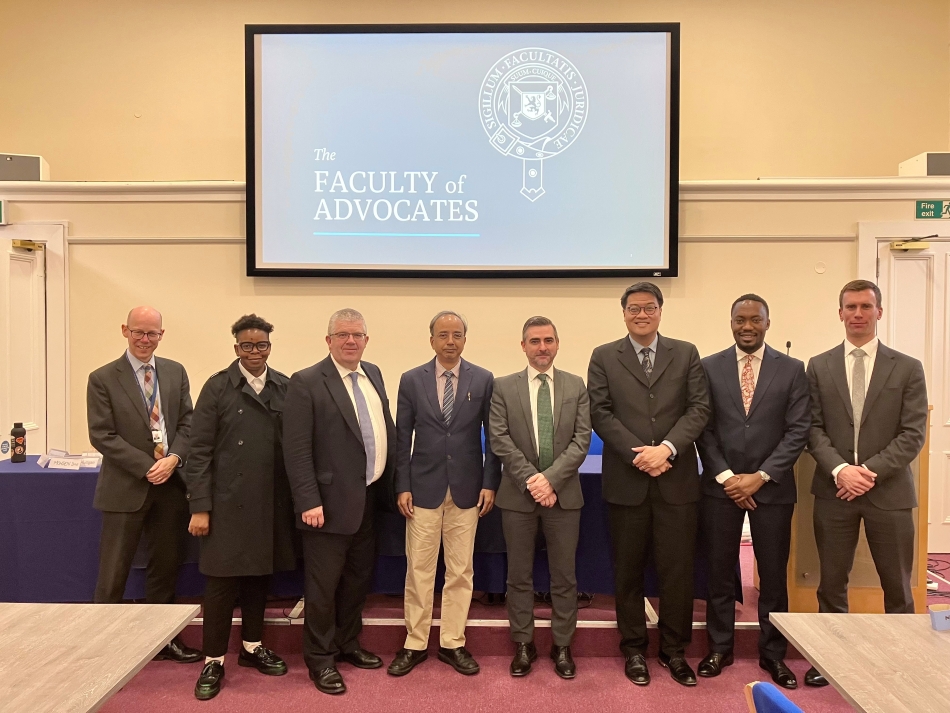
From L-R: Tim Haddow, Advocate and Deputy Convenor of Foundation Course; Buhle Lekokotla, Johannesburg Bar; Hugh Olson, Advocate and former Director of Training and Education; Dr. Sanjay Jain, Bombay Bar Association; Neil Owen-Casey, Bar of England and Wales; Darrell Low, Singapore Bar; Mmusi Seape, Johannesburg Bar; and Bruce Langlands, Advocate and Director of Training and Education at the Faculty of Advocates.
THIS year’s cohort of aspiring advocates has settled into shadowing their devilmasters in court, having completed the first part of their nine-month advocacy training at the Faculty of Advocates.
Devils – as they are known throughout their training – spend their first month completing a classroom-based Foundation Course. During this time they are exposed to the skills set required for effective oral and written advocacy through sessions delivered by Faculty instructors and guest instructors from other independent referral bars.
“Faculty operates as a centre of excellence, which is evidenced by the calibre of the training each and every devil has access to – from classroom instructors and devilmasters. The sole purpose of devilling is training and preparing them for practice. Over the years the devils, who must first have qualified as solicitors, have all been high-quality individuals so for the most part we are fine-tuning the skills they need to be successful advocates,” said Bruce Langlands, Director of Training and Education at the Faculty of Advocates. Faculty members provide the bulk of the classroom-led training, donating their time and expertise for free.
“The devils are now shadowing their devilmasters – experienced advocates with fully developed practices. They will mentor and guide them in the practical day-to-day business of being an advocate. Devilmasters carry a big responsibility – they help develop the future of the Bar through one-to-one teaching for months at a time.”
During the Foundation Course the devils spent time with advocates and barristers from England and Wales, India, Singapore and South Africa.
“International instructors often join us in training sessions throughout the year,” said Mr Langlands. “Faculty members also often do work in overseas jurisdictions. These international instructors help unpack the different ways things may be done in different places. This exposes the devils to different types of advocacy and allows them to further build their skills banks. Our Faculty instructors also get the opportunity to share their approach with their international counterparts.”
The devilling process attracts a diverse group of solicitors. Among the current cohort is Garry Ferguson, who qualified as a solicitor in 1994. He has worked in various firms focusing on commercial, insurance, and personal injury litigation and progressed his career in law from completing a traineeship through to becoming a partner in a law firm.
He switched to advocacy as he “needed a new challenge. As a partner in private practice at a law firm, you spend an increasing amount of your time on management, supervision and client care. I felt that I was no longer fully engaged in litigation, which was the whole reason that I had become a solicitor in the first place,” said Mr Ferguson.
“My fellow devils are amazing – a really great bunch of people and all very supportive of each other. The same can be said for those delivering the training. Faculty’s supportive nature has been a breath of fresh air after having been in private practice for so long. The collegiate nature at Faculty is not something I was aware of or had experienced prior to commencing devilling and it has been one of the biggest positives so far,” he added.
One of his devilling colleagues, Molly Little, qualified as a solicitor last year. Her legal career began with a specialised family law traineeship, during which she appeared in the Sheriff Court and at Children’s Hearings. “I was interested in coming to the Bar from early on in my traineeship as I quickly identified that the area of practice I enjoyed most was written and oral advocacy in the course of litigation,” she said. “I particularly enjoyed representing clients in family law cases where their ECHR rights were engaged.
“I benefited from taking part in various initiatives, including SYLA events on becoming an advocate and Faculty’s Women at the Bar Career Clinic. Engagement and encouragement from Faculty members ultimately led me to apply for a Faculty scholarship and to sit the exams to commence devilling.”
Devilling alongside the two of them is Tobias Seger, who also has a unique story to share. “I am originally from Basel, Switzerland, but moved to Scotland in 2013 to study law at the University of Edinburgh. My dad worked for the Swiss government, so I moved countries regularly growing up. Before coming to Scotland, I lived in New York for three years. I attended high school there and it was the first time I studied in English. I really wanted to continue my studies in English, which resulted in me coming to Edinburgh for university,” said Mr Seger.
“In my first week in Edinburgh, I was meeting with my personal tutor at the university to pick my courses. He told me about advocates, a profession I was not previously aware of. I immediately knew that's what I wanted to do. That belief was only firmed up when I was allowed to visit the Advocate's Library in my first year as part of the mooting society. I dual-qualified as a solicitor in England and Wales in 2024.”
In her final year of her undergraduate degree at the University of Glasgow another devil, Poppy Mulligan. was accepted into a master’s programme at an Ivy League law school in New York. She passed the New York bar exam on her 22nd birthday. Shortly afterwards she accepted a position as a fellowship attorney specialising in death penalty litigation. She worked for a non-profit in South Carolina, helping to investigate grounds of appeal and uncover mitigation evidence for individuals on death row, before returning to Scotland to complete her traineeship at an international law firm. She qualified as a commercial litigation associate in Scotland in 2021 and as a solicitor in England and Wales in 2022. She spent last year as the Judicial Assistant to Lord Hodge, the Deputy President of the UK Supreme Court.
“During my master’s, I enrolled in a trial advocacy course that introduced me to the concept of case analysis and allowed me to practice witness examination and oral submissions. The style of advocacy was more dramatic – we were encouraged to mimic the sound of gunshots in the courtroom by banging textbooks down in front of the jury – but it offered invaluable experience in advocacy, which I wanted to explore further. My first appearance in court was during a ten-week internship at the Legal Aid Society in Brooklyn, New York, where I appeared on behalf of children during abuse and neglect proceedings, as well as at emergency family conferences and case management conferences. These early experiences inspired me to pursue a career in advocacy.”
All 31 devils in the current cohort will return for classroom-based sessions for a fortnight in February/March next year focusing on advocacy skills when dealing with expert witnesses, and in specialist areas of practice – public law, family law, and commercial law. That is followed by a week of assessments, and then a further two-week skills course centred around criminal law. Their classroom-based work finishes in May with a dedicated course on appellate advocacy, both civil and criminal. In between they will continue to observe and learn from their devilmasters, which may include assisting with preparations and research in advance of hearings, as well as helping to draft formal documents, including pleadings, opinions and notes of advice. They will shadow their devilmasters in court but will not be responsible for any finished work nor appear in court to argue a case until after they call to the Bar at the end of June 2026.